“We have an impoverished democracy,
which is why we have to have massive, nonviolent, moral fusion
civil disobedience, massive voter mobilization among the poor,
and massive power building among the poor”.”
Reverend Dr. Barber, The Poor People’s Campaign
Shawna Farinango
The work of the Civil Rights Movement of the 1960s–the Civil Rights Act, the Voting Rights Act, Immigration and Nationality Act, along with legislation to implement anti-poverty programs–drew attention to the connections between racism, education, food security, employment, and health care. In 1966, Dr Martin Luther King addressed public perception that the oppressive practices of Jim Crow were becoming a thing of the past and that the Black community had “come a long, long way.” Responding to deeper, systemic root cause of poverty, Dr. King warned, “we still have a long, long way to go.” While gains have been made in the past 50 years, if we look at the 38% increase in Black students graduating from college, greater income increases than any other communities of color, and an emergent Black middle class community, “The Souls of Poor Folk,” an audit of America 50 years after the Poor People’s Campaign challenged racism, poverty, the war economy/militarism, and our national morality, reports:
racial wealth gaps have widened and patterns of gentrification pushed the poor, especially poor people of color in urban centers, further away from jobs, transportation, education and other services. The percentage of people living in deep or extreme poverty has increased since 1975. By 2016, 46 percent of people living in poverty had incomes less than half of the poverty line.
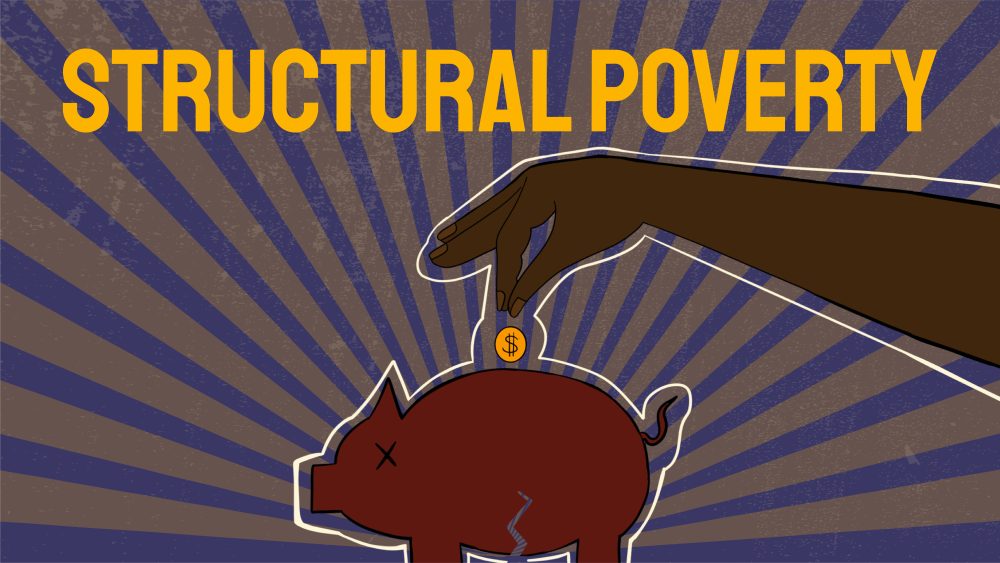
In addition to regressive policies to the Voting Rights Act, immigration and other actions that dehumanize and criminalize and oppress Black and communities of color, wealth and resources, measured by an individual or community’s net worth, is unequally distributed by race. Structural poverty is manifestation of racism and refers to the economic, educational, social institutions in the United States that contribute to systems that prey on impoverished communities while failing provide any hope through real ways out of poverty.
Two of the twelve Fundamental Principles crafted by 2018 The Poor People’s Campaign directly address the structural nature of poverty. These are:
- … people should not live in or die from poverty in the richest nation ever to exist. Blaming the poor and claiming that the United States does not have an abundance of resources to overcome poverty are false narratives used to perpetuate economic exploitation, exclusion, and deep inequality.
- … the centrality of systemic racism in maintaining economic oppression must be named, detailed and exposed empirically, morally and spiritually. Poverty and economic inequality cannot be understood apart from a society built on white supremacy.
In Black and many communities of color, poverty is intergenerational affecting the outlook for later generations. In part, this is because a high school diploma, and now more so – a college degree impacts whether your children will achieve academically. As well, neighborhoods with extreme poverty, also have high crime rates, making it more likely for children from marginalized communities to have run ins with law enforcement. Policies like ‘separate but equal’ made sure that education for African Americans was inferior; while urban renewal oversaw the creation of the housing projects whose policies concentrated low income families Black families in one area.
Because of these historical legacies, many Black and Brown families lack of available resources to obtain resources to choose better schools or housing , resulting in continued disadvantages for present and future generations. Housing policy favors those already wealthy enough to buy a home and leads to displacement and economic segregation. Tax policy frequently favors the wealthy. Unequal education opportunities contribute to the entrenchment of poverty. Stereotyping by police discriminates against impoverished communities where a higher police presence is noted. Aggressive policing not only increases the likelihood of altercations between officers and community members, as well as takes community members out of the workforce, it also perpetuates the idea that impoverished people are a risk and are in need of more constant monitoring than others. Communities without resources are often more vulnerable, with little voice in matters of law enforcement, housing policies and educational matters.
Sources
https://policy.m4bl.org/economic-justice/
http://theweek.com/articles/573307/end-police-violence-have-end-poverty
Long Term Effects of Parents Education on Children’s Educational Success
https://www.ncbi.nlm.nih.gov/pmc/articles/PMC2853053/
How Black Middle Class Kids Become Poor Adults
https://www.theatlantic.com/business/archive/2015/01/how-black-middle-class-kids-become-black-lower-class-adults/384613/
Forgotten History of Housing Segregation
Poverty rates for Black Children remain steady
Black wealth doesn’t matter much
What are some responses to this problem?
The Poor People’s Campaign: Get Involved and Take Action!
https://www.poorpeoplescampaign.org/join-campaign-get-involved-state/
The New Jim Crow: Get Involved and Take Action!
Take Action
Structural Solutions to poverty
https://www.newamerica.org/asset-building/the-ladder/poverty-is-structural-so-are-solutions/
Common sense & creative ways to address structural poverty
http://www.motherjones.com/politics/2014/06/richmond-california-murder-rate-gun-death/